One developer instead of an agency: an ecommerce case study. I took the Parandis Bud online store from design to Google Ads on my own, with warehouse sync, admin, SEO and analytics, for a fixed $5,000. Real ad screenshots, the problems that hurt most, and an honest list of what I'd change.
- Published
- Reading
- 19 min
- Author
- Yaroslav Tsarenko
Short answer: yes, one person can replace an agency. I built Parandis Bud, a building-materials store in Khmelnytskyi, Ukraine, solo, from design to Google Ads, May to November 2026, for a fixed $5,000. Spoiler: according to the client, in the first month of ads a buyer found the store through Google Ads and placed a UAH 250,000 order with the manager.
How does an online store usually get built? A designer, two developers, an integrations engineer, an SEO specialist, an analyst, an ads person, and a project manager trying to keep them all in one room. Sound familiar? On this project I sat in all eight chairs. From an empty repository on May 19, 2026 to a live Google Ads search campaign. From the home page layout to a script that hauls warehouse stock every hour off a server running Windows Server 2008 R2.
This isn't a how-to. I already wrote the step-by-step guide to a store that sells in month one. This is an ecommerce website case study from the inside: which hats I wore, where it hurt, what it cost, and what I'd do differently. I'm proud of this project. That's exactly why I'll show you where I got it wrong.
Key facts
| Project | Parandis Bud, a building-materials online store in Khmelnytskyi, Ukraine; official Ceresit dealer |
| Team | one person, me: design, development, integrations, admin, SEO, analytics, ads |
| Timeline | first commit May 19, 2026; two sprints: May–June and October–November 2026 |
| Stack | Next.js 16, React 19, TypeScript, MongoDB, Tailwind CSS 4, Vercel |
| Catalog | 449 products in 66 categories, 6 material calculators |
| Integrations | BAS (1C family), Nova Poshta, Ukrposhta, Cashalot, LiqPay, Telegram, OpenAI, GA4 and GTM, Merchant Center, Google Ads |
| Budget | a fixed $5,000 for the whole cycle, excluding ad spend |
| Ads, Oct 31–Nov 6, 2026 | 1.11K clicks, 30.8K impressions, UAH 3.49 per click; impression share 37% vs 13% for Epicentr |
| Visibility in Google | 459 products approved in Merchant Center, 299 pages indexed by Google |
| Result | UAH 251,644 revenue for Nov 1–7, 2026 in the store admin, including a UAH 250,000 wholesale order whose buyer came from Google Ads, according to the client |
The full case with screens is on the Parandis Bud portfolio page.
What did Parandis Bud need?
A store that sells across Ukraine, shows real warehouse stock, and that the owner runs himself, without a developer on speed dial. That's the whole brief. Sounds like one project, right? It was five.
Before me, the store had a site on nopCommerce (an ASP.NET e-commerce platform), and Google still remembers its product URLs. The actual jobs:
- sell across the whole country, not only to people who can drive to the warehouse;
- show prices and stock that match the warehouse, not a spreadsheet someone forgot to update;
- answer the buyer's real question: how many bags do I need for my area;
- let the owner run everything himself: products, orders, promotions, shipping labels;
- get traffic from day one, which means launching ads and analytics together with the site.
The budget: a fixed $5,000 for the whole cycle. No hourly billing, no "that's a separate estimate." And with a fixed price, every handoff between people costs me, not the client. The conclusion wrote itself: no handoffs.
One developer instead of an agency: which eight roles did I cover?
Eight roles an agency normally hands to different people: designer, frontend, backend, integrations, admin product owner, SEO, analytics and ads. The brief needed all of them. So who was I to say no?
No illusions, though: one person is not eight people for the price of one. It's a different way of working, with its own upside and its own risks.
Agency
- Several people in parallelfaster when there is a lot of work
- Handoffs between rolesbrief, mockup, spec, sign-off, and context leaks at every step
- Blurred ownership“not our part” when the ads don't sell
One developer
- One head holds the whole contextdesign knows about stock, ads know about the calculator
- No handoffsfrom idea to production in a day
- One person is the bottlenecka holiday or illness stops the work
The biggest win isn't the price. It's context. I'm drawing the product card and I already know the price per bag has to match the Merchant Center feed, and that the "Add to cart" button under the calculator has to fire an add_to_cart event with the right quantity. At an agency, that's three people and two meetings. Here it's one thought.
The biggest risk is also me. If I get sick, the project stops. So the code lives in the client's own GitHub organization, every service is registered to the store's email, and since June 2026 every change has gone through its own pull request saying what changed and why. If I vanished tomorrow, another developer could pick it up.
How long did it take to build the online store?
The first working version took three days, May 19 to 21, 2026. The store that actually sells took two sprints with a pause in the middle: May to June, and October to early November.
- May 19–21First versionstore, admin, Nova Poshta and AI product copy in three days
- JuneCatalog at scaleExcel import, product table, templates
- July–SeptemberFirst version in usedevelopment paused, the site runs as is
- October 2Audit: 24 out of 100an honest review of my own version, then a redesign
- October 3–21A store that sellscalculators, feed, analytics, new admin, carriers, receipts
- October 13–31Ads and warehouseGoogle Ads, bot protection, SEO, BAS sync
- NovemberPolishdiscounts, old URL redirects, manual orders
Those three days in May produced the catalog, cart, admin, Nova Poshta delivery and product descriptions written with OpenAI. June added Excel import, a product table and templates. From July to September the site ran on that version.
Then, on October 2, 2026, I did something I recommend to everyone: a brutal conversion audit of the live site, as if someone else had built it and I owed them nothing. Eleven areas, from first impression to copy. My own first version's score? 24 out of 100.
It stung. See for yourself:
- The live header showed a placeholder phone number.
- Search couldn't find "CM 117" because the product title used a Cyrillic "М" instead of a Latin "M".
- There was no material calculator.
- There was no analytics. None.
- In one in-browser measurement the home page weighed about 26.8 MB, mostly PNG category tiles of around 2 MB each.
- Nobody at the store was told about new orders.
Familiar list? That audit became the plan for the second sprint, which produced most of what you see on the site today. Shipping that first version without analytics and contacts was my mistake, and I'll come back to it.
How do you build a product page that answers "how much do I need"?
The product page should do the math for the buyer: they enter their area, get the number of packs, and drop them in the cart with one tap. Nobody buys plaster like a T-shirt. People arrive with a job: tile 24 m², pour a floor. So the center of the design wasn't the home page. It was the product page.
Six calculators. Tile adhesive, primer, plaster (with a gypsum or cement switch), floor leveler, grout and suspended ceilings. Enter the area, see the number of packs. The owner tweaks formulas, coefficients and the safety margin in the admin and tries them in a sandbox first.
Search that forgives. Building-materials buyers search by model code: "CM 11", "CT 17". Half the catalog titles mix Latin and Cyrillic letters. So search folds look-alikes into one form (Latin M and Cyrillic М, C and С, the Ukrainian г and ґ), understands common phrasings of "tile adhesive", and finds the product whichever alphabet the code was typed in. Not a new idea: Unicode has a whole standard on visually confusable characters, usually aimed at phishing. Here it sells plaster.
The first screen. Price, a call button and "add to cart," all visible without scrolling. Sheet goods show a price per square meter. And outside business hours (Monday to Friday, 9:00 to 18:00 Kyiv time) the call button doesn't ring an empty office. It opens a "call me back" form that analytics counts as its own event.
Speed. After the audit I rebuilt the home page. The header now gets only category names and URLs, not full records. Product cards use one 480 px Cloudinary image instead of a srcset that reached for 1920 px. Calculator data loads only as the block approaches the viewport. Home page HTML dropped from 734 KB to 483 KB. Why every kilobyte on a phone is money is in my Next.js App Router production guide.
Which integrations does an online store in Ukraine need?
An accounting system, carriers, fiscal receipts, online payment, alerts and Google services. Parandis Bud is wired to twelve external services.
Under the storefront: Next.js 16, React 19 and TypeScript, MongoDB through Mongoose, hosting on Vercel. But the store itself is only the middle of the map. Most of the backend work here was integrations.
What usually gets forgotten, and is here:
- Shipping labels straight from the admin. A manager creates a Nova Poshta or Ukrposhta waybill from the order card instead of retyping the address in the carrier's portal. A scheduled job also creates waybills for eligible orders that don't have one yet, with retries.
- Fiscal receipts through Cashalot are issued and emailed to the customer. The fiscal shift closes itself every evening.
- Card payments with a signed, idempotent callback: a retry or a late response can't mess up an order that's already paid. Invoice and cash on delivery stay available too.
- Telegram gets every order, every lead, and even abandoned forms where someone typed a phone number and never pressed the button.
- Protection from bots and pranksters. Vercel BotID, request limits, risk flags and a blocklist. Every session gets a verdict: human, suspicious, bot or crawler.
Think that last one is about security? So did I. It turned out to be about ads. The moment the campaign went live, fake orders and spam leads rolled in, and Google Ads started learning from them as if they were real conversions. The fix was simple: flagged orders no longer send purchase or lead events. The algorithm learns from real people.
How do you connect a BAS (1C) warehouse to an online store?
Through the standard CommerceML exchange: BAS exports the catalog and stock, the site imports them, and products are linked to warehouse items by a GUID that never changes. Sounds like an afternoon's work. Here's where it got interesting: at Parandis Bud, not a single step worked out of the box.
Store staff kept running to the phone to check whether a product was really in stock. The warehouse lives in BAS, a 1C-family accounting system widely used in Ukraine. Obvious task: let the site pull stock from there. What followed were four surprises.
Surprise one: the server can't reach the site. BAS runs on Windows Server 2008 R2. Microsoft released it in October 2009, and its extended support ended on January 14, 2020 (Microsoft Lifecycle). This server can't open a TLS 1.2 connection, so BAS simply can't talk to a modern HTTPS endpoint. And nobody was going to upgrade the client's server for the sake of a store.
So how did I solve it? BAS exports to a folder. A PowerShell 2.0 script with a bundled curl.exe, which brings its own TLS, ships the files to the site every hour through Task Scheduler, following the standard exchange protocol. It skips files it already sent and files BAS is still writing, keeps the password off the command line, and logs every run. It's been running on the client's server since October 29, 2026.
Surprise two: files bigger than the host accepts. Vercel Functions take request bodies up to 4.5 MB. The full BAS catalog is about 15,000 items. So the files travel in 3.5 MB parts.
Surprise three: portions that wiped the stock. BAS can split an exchange into portions of a hundred products and mark each one as a full package. My first import dutifully zeroed everything missing from the current file. The result? Each portion erased the stock the previous one had just written. Now an item is zeroed only if no file has mentioned it for three hours.
Surprise four: names that don't match. BAS item names are abbreviated shorthand with their own spelling and sizes like "4,2*16". The site speaks plain language. Automatic matching happily picked the wrong color and the wrong thickness. So linking goes by GUID, and the admin shows the three closest BAS items for each product, with stock and price, auto-ticking only the matches that are safe. One store product can link to several warehouse items. The sync never touches store prices.
None of this was in the brief. An agency would have sent a separate invoice for each after a change request. I had a fixed budget, so I just worked through them one by one. Otherwise "stock from the warehouse" would have stayed a nice promise.
What should an online store admin do?
Let the owner manage products, orders, promotions and stock without a developer. A store only a developer can change is a bad store. So I built the admin as a product in its own right.
- Orders in three views: a table, a drag-and-drop kanban by status and a timeline. Every order remembers its status history. A manager can create an order by hand, say, after a phone call.
- Products: a table with bulk actions and 55 templates for typical products. The gpt-4o-mini model fills the fields right in the form, and the manager checks the result and saves it.
- Excel import with a diff and undo. Before anything is applied, the admin shows exactly what will change. Bad import? Roll it back. Product URLs never change in the process, so SEO doesn't break.
- BAS warehouse: product linking, export to Excel, CSV or ODS, and draft products from BAS groups the site doesn't carry yet.
- Scheduled promotions and promo codes. An hourly job switches discounts on and off and refreshes the feed. A sale in Google Shopping never outlives the sale on the site.
- First-party visitor analytics: where a visitor came from, what they viewed, how long they stayed, whether they tapped "call," and whether they turned into an order.
How do you launch SEO, analytics and Google Ads with a new store?
Build them into the code before launch instead of bolting them on later: structured data, the feed, GA4 events and the campaign structure all rest on the same data as the storefront. At an agency that's a separate department. Here it was just the next commit.
Structured data. Pages carry schema.org markup for the store, products with offers and shipping, breadcrumbs and FAQ, matching both the visible text and the feed. Empty categories stay out of the index, filtered views are self-canonical, and an llms.txt file helps AI search make sense of the catalog. Why that now affects leads is in my article on websites in the age of AI search.
Merchant Center. Four steps: create the account, verify the site, add the feed by URL, set up shipping. The feed is built from the same data as the site. As of November 7, 2026 it holds 461 offers.
Old URLs. Search Console kept crawling URLs from the previous site, like /ceresit-стяжка, and hitting 404s. For a site move, Google recommends permanent server-side redirects. There was no ready "old URL → new URL" table, though. So since November 4, 2026 the site parses each old address for the model code and sends it to the closest product. No match? A search for that code. Junk gets an honest 404.
Analytics. GA4 through Google Tag Manager with six e-commerce events, from view_item to purchase with user data for enhanced conversions. Calls, Viber taps, leads and calculator use are tracked separately. And here I slipped. The consent banner was shown to everyone, and until someone tapped it, analytics stayed silent. Google simply didn't see most of the calls from ads. Now consent is set by region through Consent Mode: strict mode for the EEA, the banner for foreign visitors, and earlier "necessary only" choices still honored. Tag Manager loads after the page has painted, so it doesn't slow the first screen.
Ads. I started with search, not "everything at once." The initial campaign: 13 ad groups by category, 178 keywords and 21 negative keywords. Later I added local queries for Khmelnytskyi and five more groups. Category groups land on their category pages, not the home page. A separate search campaign, "Будмагазин Хмельницький," catches local "building store" queries, and once the feed passed review a Shopping campaign for the Khmelnytskyi region joined in. For Performance Max I prepared images and logos, but its turn comes once it's clear which products sell.
What did the ads deliver in the first week of November 2026?
In the week of October 31 to November 6, 2026, the ads brought 1.11K clicks at an average of UAH 3.49 each, and the store admin shows UAH 251,644 in revenue for November 1–7. Enough talk. Below are real screenshots from the store admin, Google Ads, GA4, Merchant Center and Search Console, interfaces in Ukrainian and English as they appear in the accounts.
How much revenue did the ads bring?
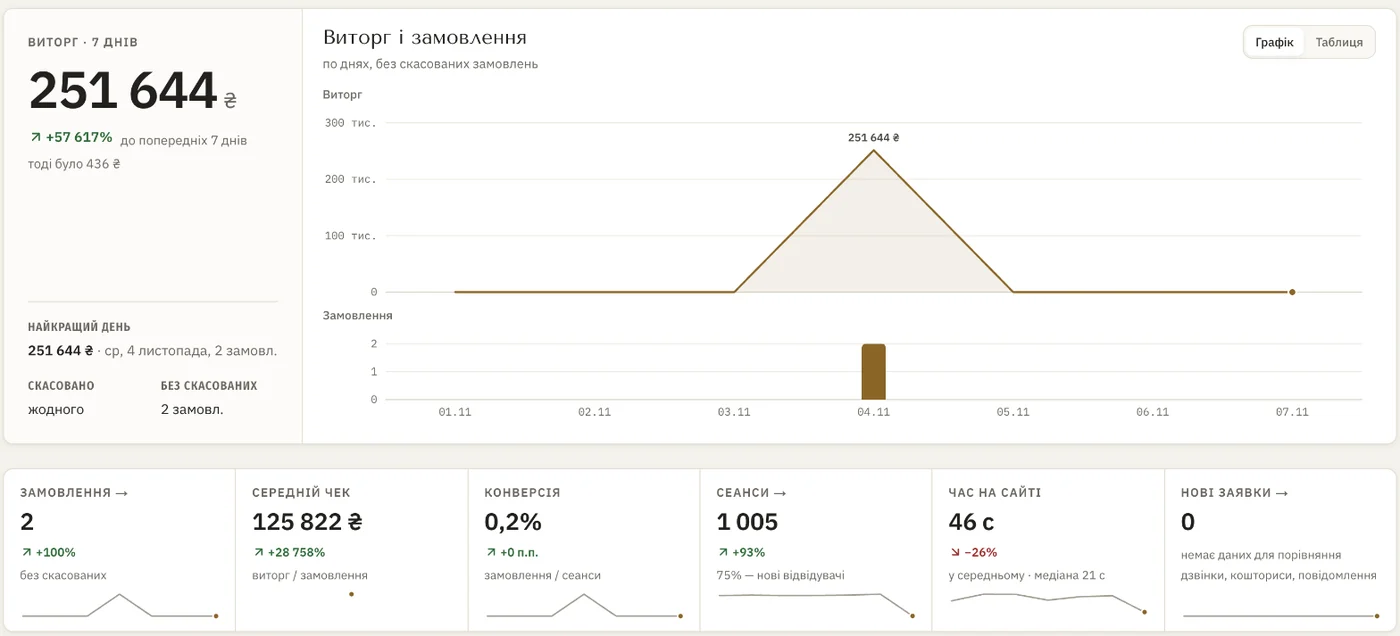
The admin report: UAH 251,644 for November 1–7, 2026 and two orders, both on November 4. Zero cancellations. Most of that is one wholesale order of UAH 250,000.
Now, to be straight with you: that order didn't go through the cart. According to the client, the buyer found the store through Google Ads and sorted it out with the manager, who then entered it in the admin by hand with "Google Ads" as the source. That's exactly why I added manual orders with a traffic source to the admin on November 6.
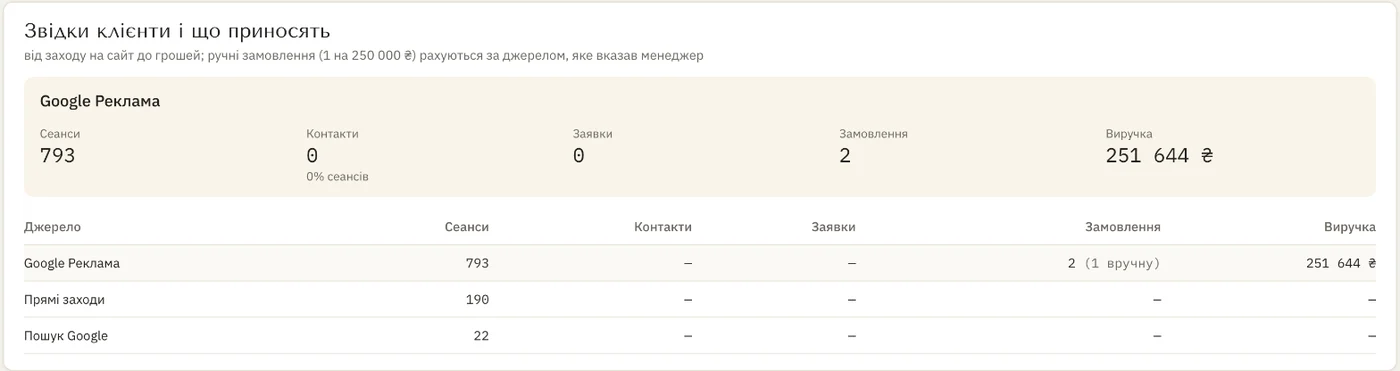
In the source report, Google Ads accounts for 793 sessions, both orders and UAH 251,644. Direct visits: 190 sessions. Google organic search: 22. Yes, SEO for a new site is only warming up. The second order, UAH 1,644, was placed on the site, and the same 1,644 shows up as the ad campaigns' conversion value in Merchant Center below.
How does the store compare with Epicentr in Google Ads?
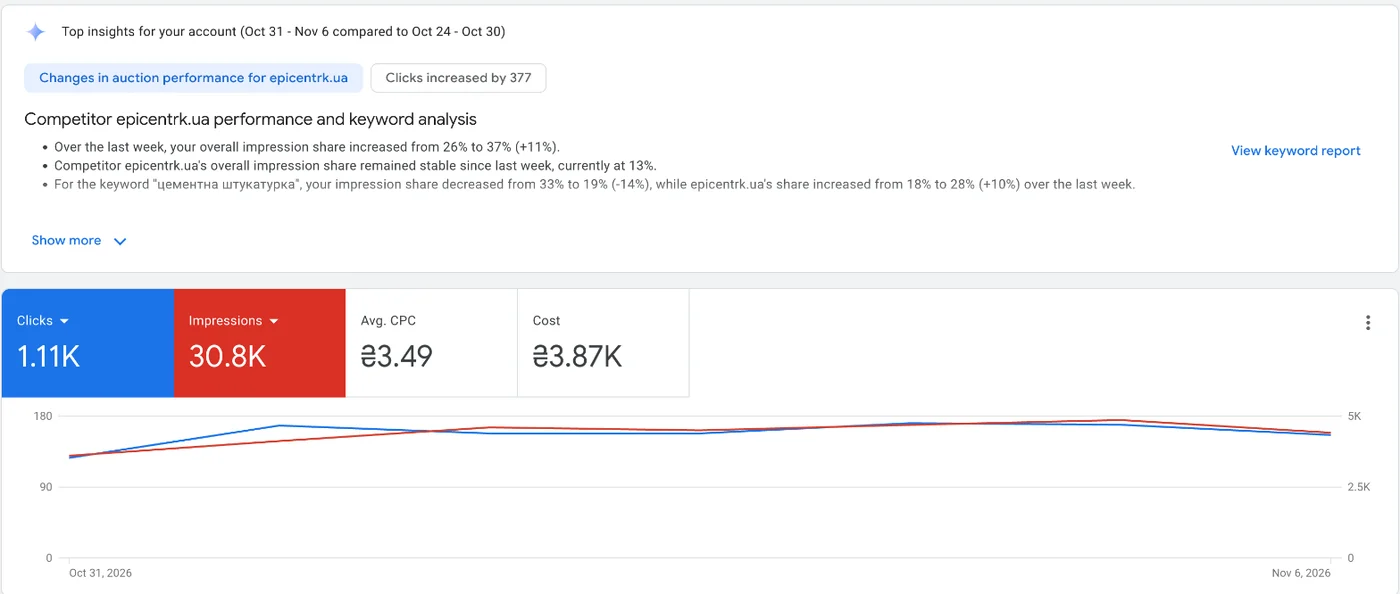
The week of October 31 to November 6, 2026: 1.11K clicks, 30.8K impressions, an average CPC of UAH 3.49 and UAH 3.87K in cost. According to Google Ads, the store's overall impression share rose from 26% to 37% over the week. The retailer Epicentr (epicentrk.ua) held steady at 13%. Clicks were up 377 on the previous week.
Not all sunshine, though. For the query "цементна штукатурка" (cement plaster), our impression share fell from 33% to 19% in the same week, while Epicentr's rose from 18% to 28%. Ads are weekly work, not set-and-forget.
Which ad is shown most often?
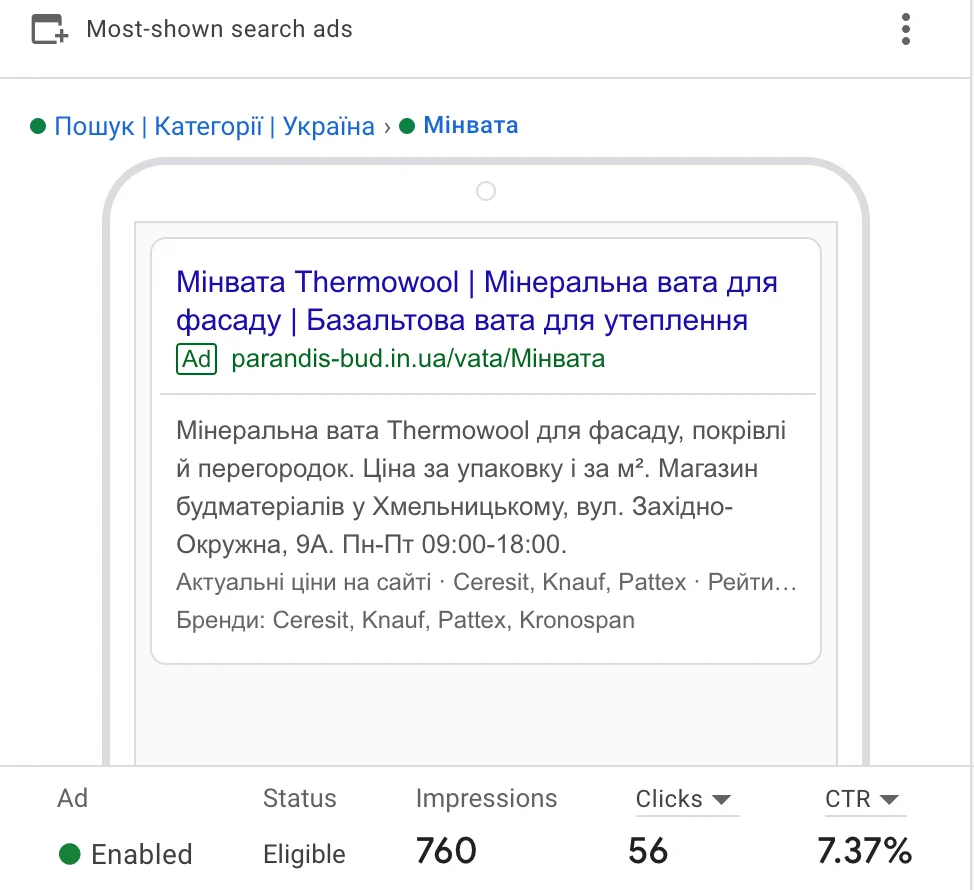
The front-runner is the mineral wool ad: 760 impressions, 56 clicks, a 7.37% CTR. Why does it work? Because it answers precisely: the Thermowool brand, what it's for, the price per pack and per square meter, the address and opening hours. Google rates most of the campaign's responsive search ads as Excellent.
What do buyers search for, and on which devices?
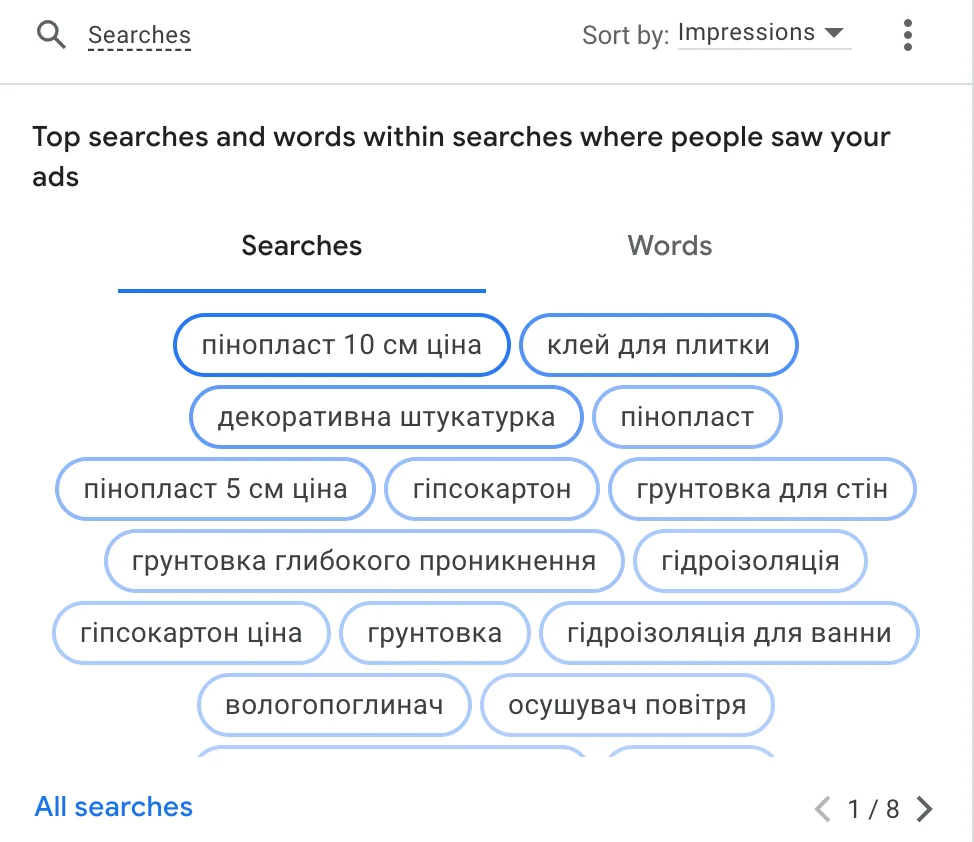
The top queries that triggered the ads include "пінопласт 10 см ціна" (10 cm foam board price), "клей для плитки" (tile adhesive), "декоративна штукатурка" (decorative plaster), "гіпсокартон" (drywall) and "грунтовка для стін" (wall primer). Exactly the categories I built ad groups and calculators around.
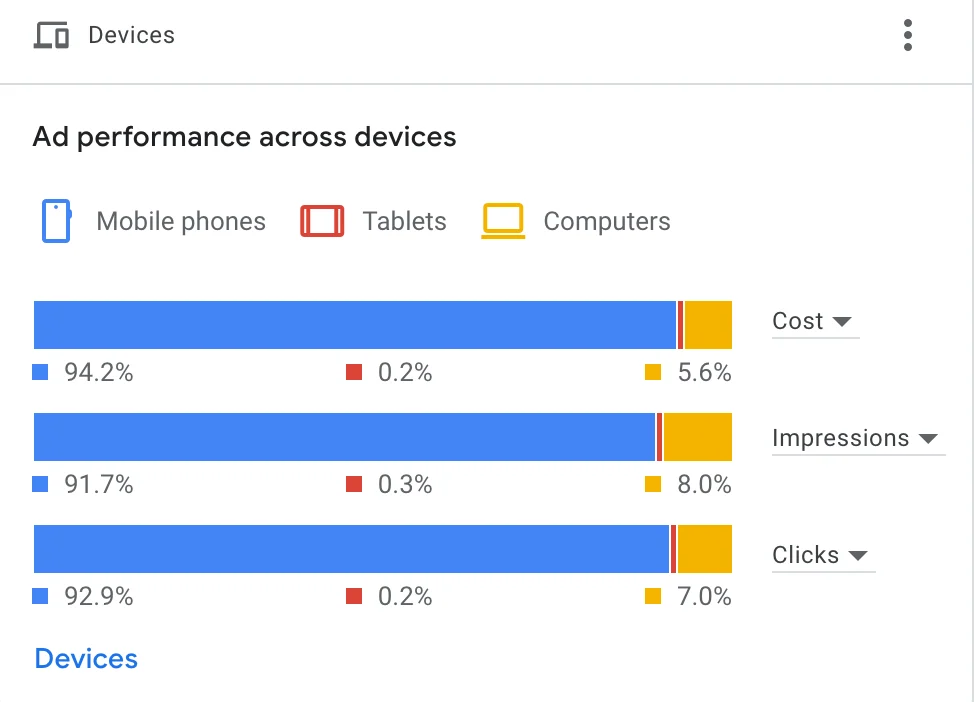
92.9% of clicks, 91.7% of impressions and 94.2% of cost come from mobile phones. That's why the first screen of the product page, with the price, a call button and "add to cart," mattered more than any animation on the home page.
What do GA4, Merchant Center and Search Console show?
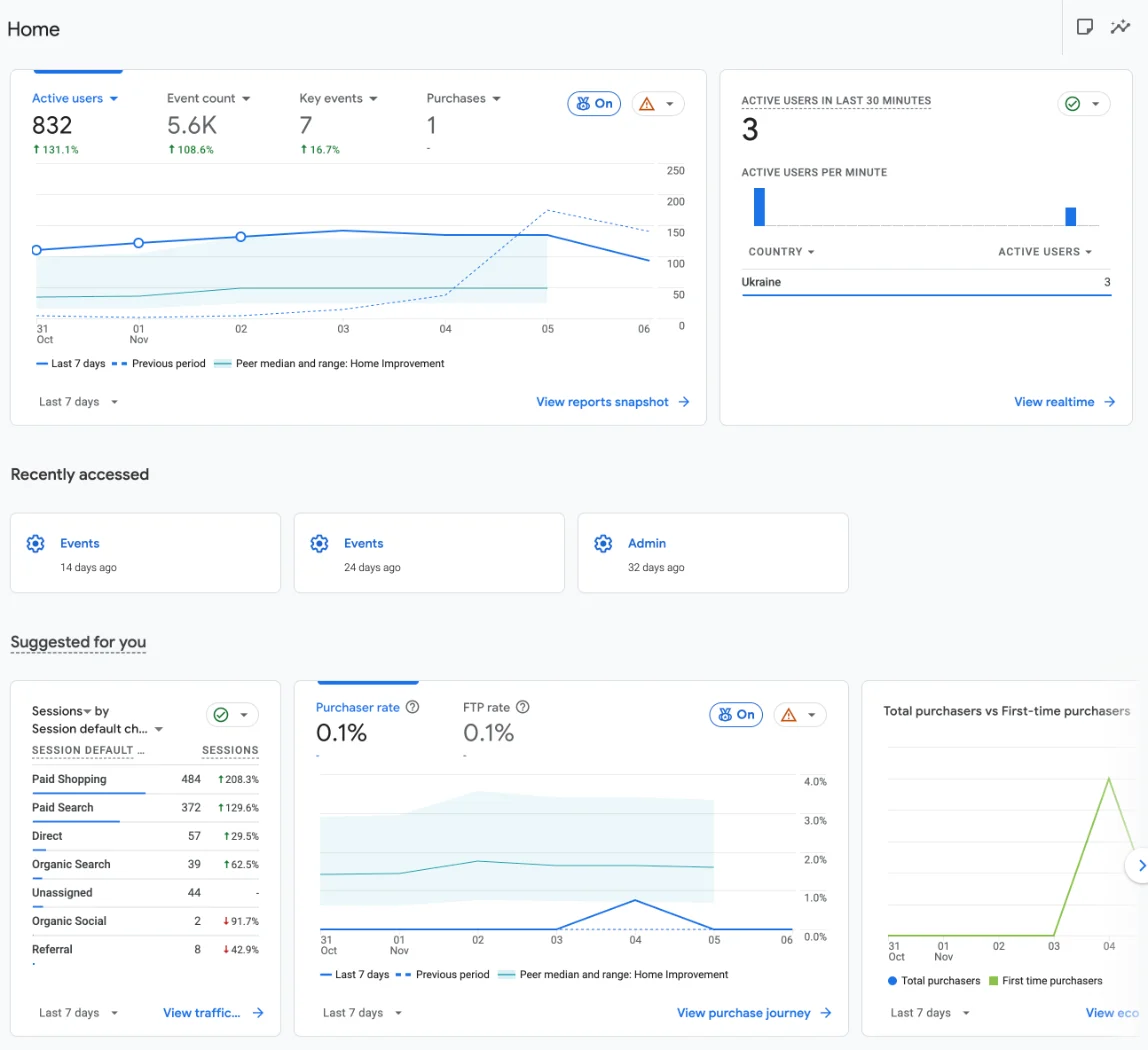
GA4 for the last 7 days: 832 active users (+131.1%), 5.6K events (+108.6%), 7 key events and 1 purchase. Paid Shopping brought 484 sessions (+208%), Paid Search 372 (+130%).
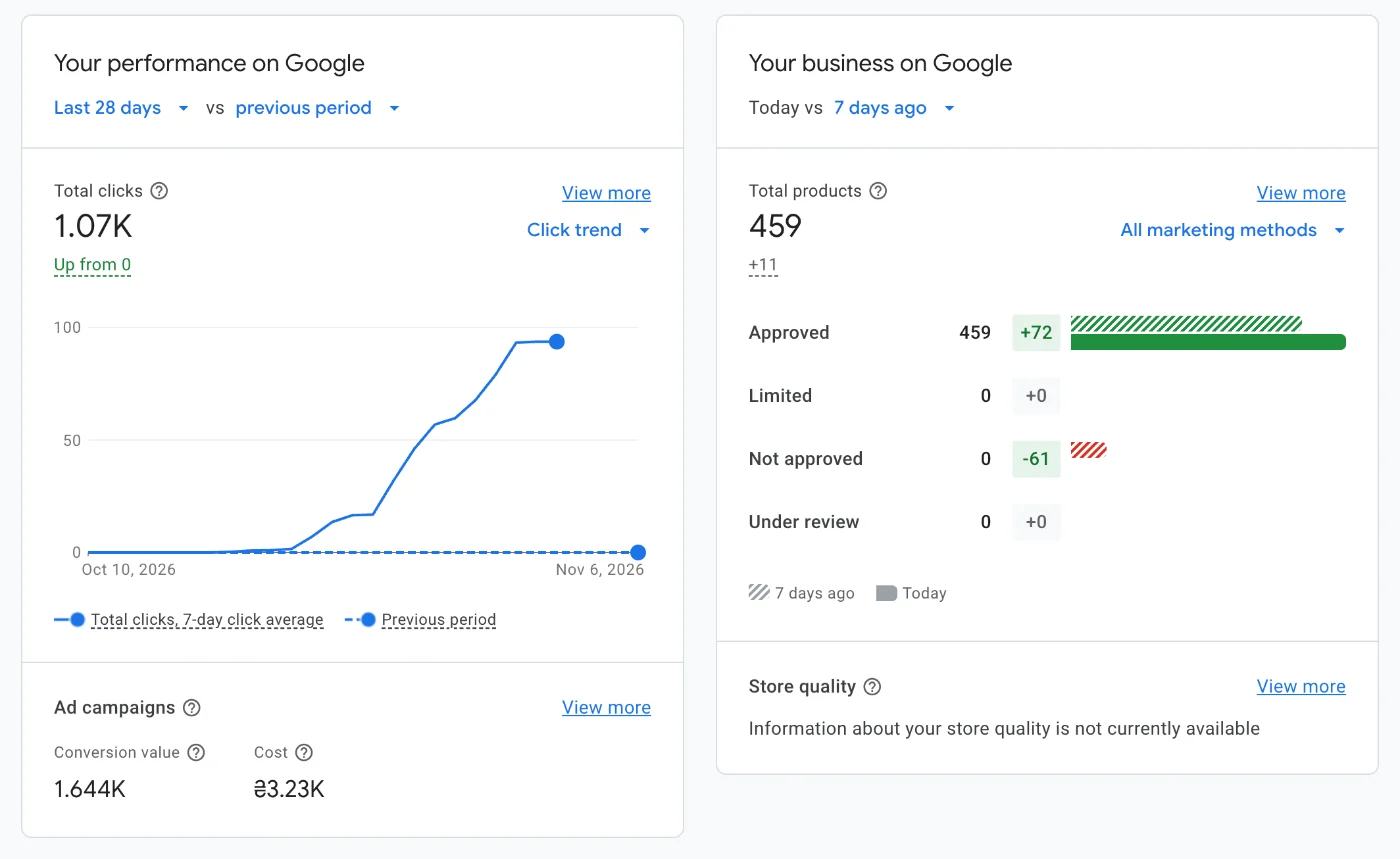
Merchant Center: 1.07K clicks in 28 days, up from zero in the previous period. All 459 products are approved: 72 more were approved during the week, and not-approved products went from 61 to 0.
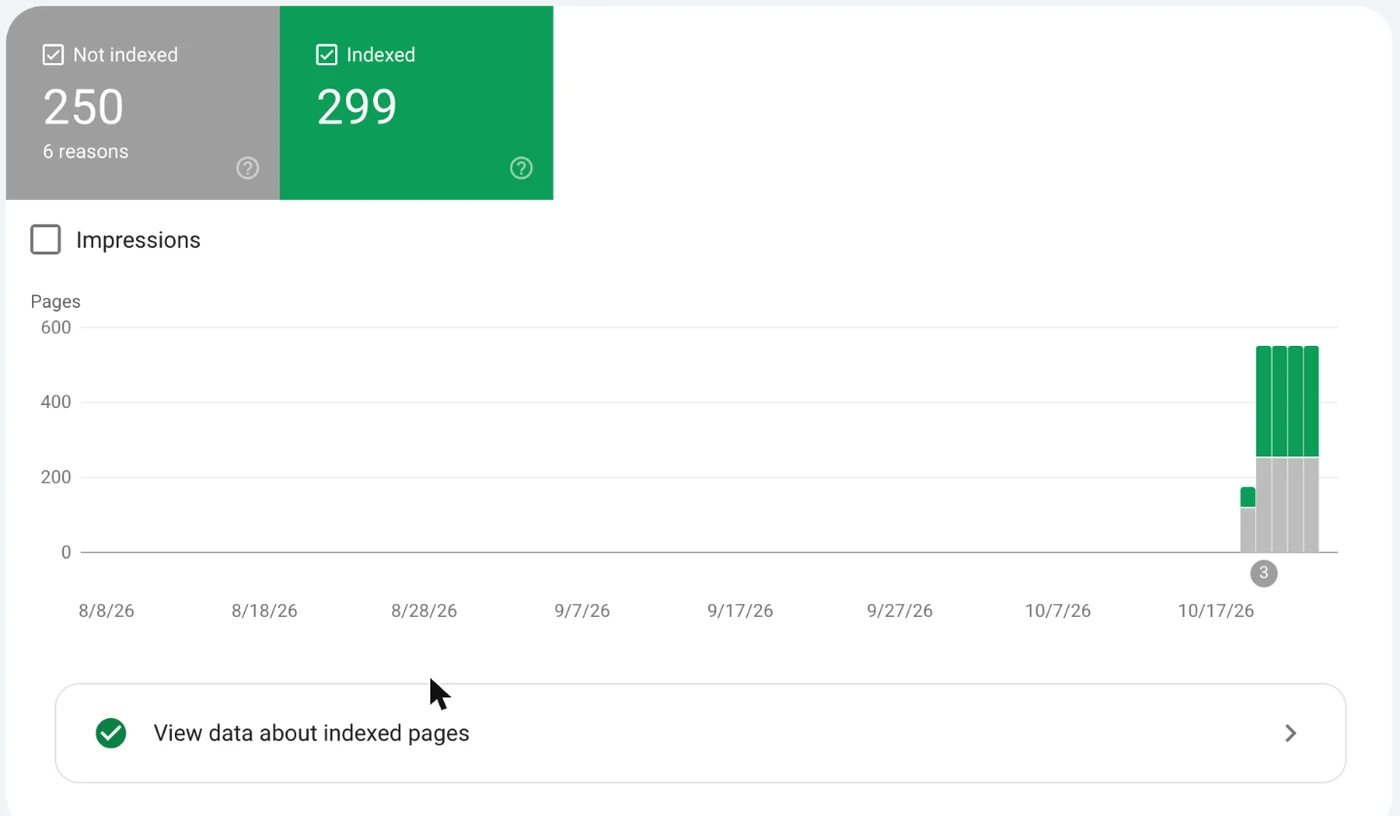
At the end of October 2026, Search Console counted 299 Parandis Bud pages in Google's index and 250 not indexed, for six reasons.
How much does a custom online store from one developer cost?
Parandis Bud cost a fixed $5,000 for the whole cycle. That covers design, the store, the admin, every integration on the map above, the BAS sync, SEO, analytics and the ad setup. The client pays Google for the clicks themselves separately.
The result I'm proud of: according to the client, in the very first month of ads a buyer found the store through Google Ads and placed a UAH 250,000 wholesale order with the manager. One order isn't statistics, and I won't dress it up as an average. But it shows why the whole chain mattered: the ads brought a buyer to a store where prices, stock and contacts already worked.
What would I do differently?
Five things. And none of them is specific to this project.
- I wouldn't ship the first version without contacts and analytics. The store spent the whole summer of 2026 with a placeholder phone number and not a single GA4 event. Three months of real buyer data, gone.
- I'd ask about the accounting system in the very first meeting. Not "do you use 1C," but "which server does it run on, and can it make an HTTPS request." Hearing "Windows Server 2008 R2" on day one would have saved several days.
- I'd set up bot protection before the ads, not after. Fake orders after launch taught Google the wrong lesson.
- I'd check caching against the platform's limits. A 5-minute catalog data cache in the shared layout quietly forced every page to regenerate every 5 minutes and burned through the regeneration quota. Pages now refresh daily and right after admin edits.
- I'd align the consent banner with the ad plan before launch. Otherwise the first weeks of ads optimize on half the data.
Notice the pattern? Nearly all of these mistakes are born where roles meet. At an agency they wouldn't disappear. They'd just be spread across people who never see each other's work.
When is one developer better than an agency, and when not?
One developer wins when there's a clear brief and custom logic that has to live in one head. An agency wins when you need lots of parallel work, ongoing management, or 24/7 on-call coverage. Agencies have their place. Just not every place.
| Situation | What fits | Why |
|---|---|---|
| A small-business store or website with a clear brief | one developer who owns the full cycle | no handoffs, one owner, a fixed price |
| Custom logic: calculators, stock from accounting, wholesale | one developer or a small team | understanding the whole chain matters more than headcount |
| A large volume of parallel work on a tight deadline | an agency | several people really are faster than one |
| Daily ad, content and social media management | an agency or dedicated specialists | it's ongoing operations, not a project |
| A critical service where downtime is unacceptable | a team with on-call rotation | one person can't be available 24/7 |
Going with one developer? Check three things. The code and every account are yours: GitHub, hosting, Google Ads, GA4, Merchant Center. There's a change history another developer could follow. And the person can show you a live project, not just mockups. How to compare estimates from different contractors is in my article on MVP development cost in 2026; the logic is the same for a store.
Parandis Bud isn't unique. Every niche has its own "how much do I need," its own accounting system, and its own old URLs that Google still remembers. I build online stores and business websites from design to ads, and you talk directly to the person writing the code. More on how I work is on the website development page. Tell me what you have now, and I'll tell you where I'd start.
Was this useful?
– likes · – views
Questions people ask
Can one developer replace an agency?
For a small or mid-sized business store or website, yes, as long as that person genuinely handles design, code, integrations, SEO, analytics and the ad launch. The upside: no handoffs between contractors. The catch: everything rests on one person, so the code, accounts and change history must belong to you, not to them.
How much does a custom online store from one developer cost?
Parandis Bud cost a fixed $5,000 for the whole cycle: design, a Next.js 16 store, the admin, carriers, fiscal receipts, warehouse sync with BAS, the Merchant Center feed, analytics and the Google Ads search campaign setup. The client pays Google for the clicks themselves separately.
How long does it take to build an online store?
The first working version of Parandis Bud took three days, May 19 to 21, 2026. The store that actually sells, with calculators, integrations, warehouse sync, analytics and ads, came together in two sprints: May to June and October to early November 2026.
How do you connect an accounting or ERP system's stock to an online store?
Use the exchange format the system already speaks. For BAS and 1C that's CommerceML: the accounting system exports the catalog and stock, the site imports them. Link products to accounting items by a stable GUID, not by name, because accounting names are abbreviated shorthand that never matches the storefront.
How do you connect Google Merchant Center to your store?
Four steps: create the account, verify the site, add the feed by URL and set up shipping. The one rule that matters: build the feed from the same data as the site, so prices and stock in Google never drift from the storefront. The Parandis Bud feed holds 461 offers.
What should you do with old product URLs when you move to a new store?
Don't serve 404s where people and Google still arrive. Google recommends permanent server-side redirects to the matching new pages. At Parandis Bud, an old address is parsed for the product model code and sent to the closest product, or to a search for that code if there's no match.
What results can Google Ads bring a new online store?
For Parandis Bud, the week of October 31 to November 6, 2026 brought 1.11K clicks and 30.8K impressions at an average cost of UAH 3.49 per click. The store's impression share rose from 26% to 37%, while the retailer Epicentr (epicentrk.ua) stayed at 13%. According to the client, the buyer behind a UAH 250,000 wholesale order found the store through Google Ads.