Case study · own product, learning app
Loo
Learning as a game you can't cheat, five minutes a day.
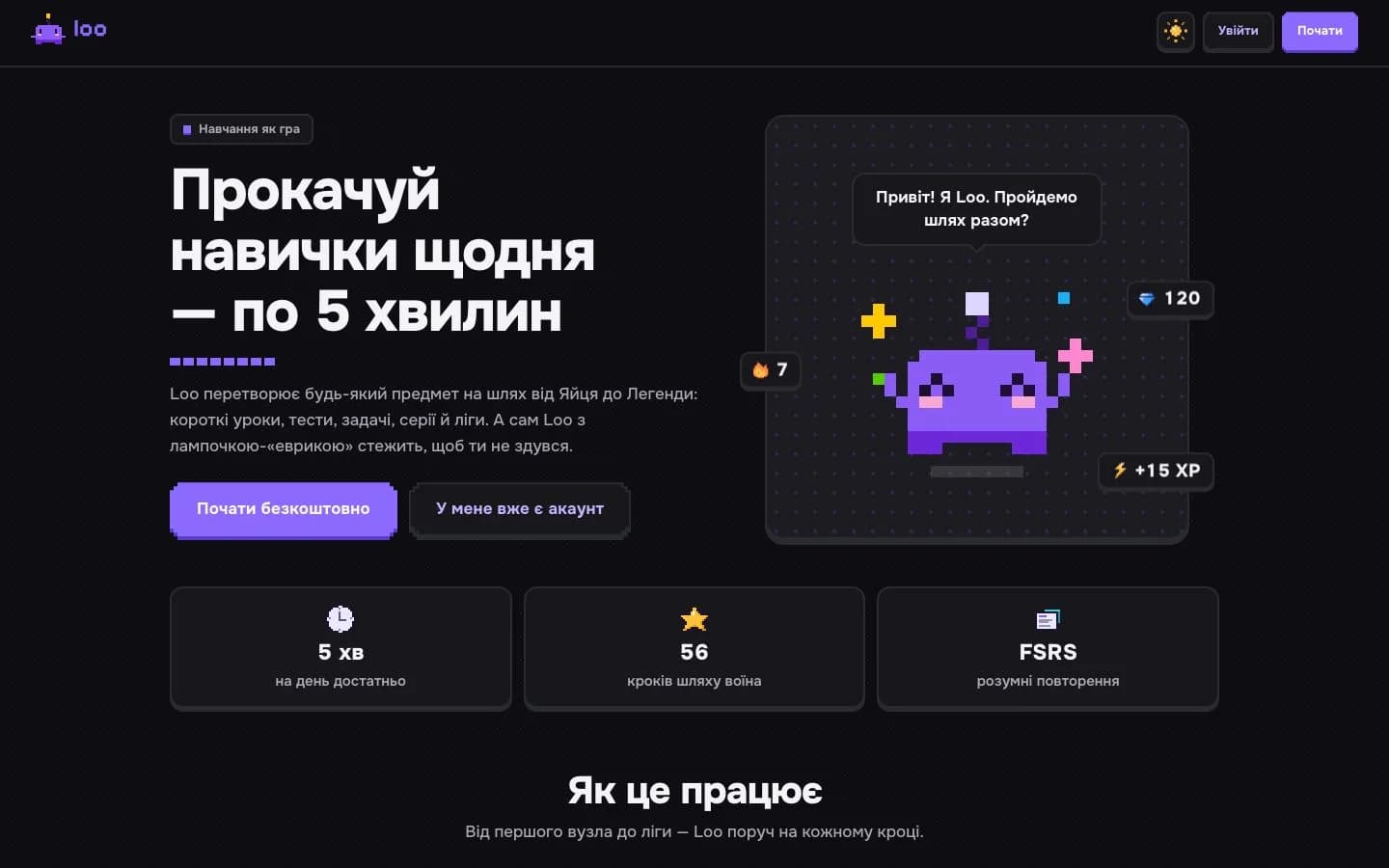
Loo is my own Duolingo-style app for Ukrainian speakers. Any subject becomes a path of short lessons, tests and repetitions; learners earn XP and currencies, keep streaks, climb weekly leagues and dress a pixel mascot. I designed and built the product end to end: the course compiler, the learning engine, the game economy, analytics, admin and the blog.
- My role
- Product and full-stack engineer
- Product
- Own product · playloo.app
- What I built
- Learning app · course compiler · admin
- Who uses it
- Learners on web and phone (PWA)
2,361
lessons in the English A1 → C2 course
9,375
English exercises across 166 topics
4,287
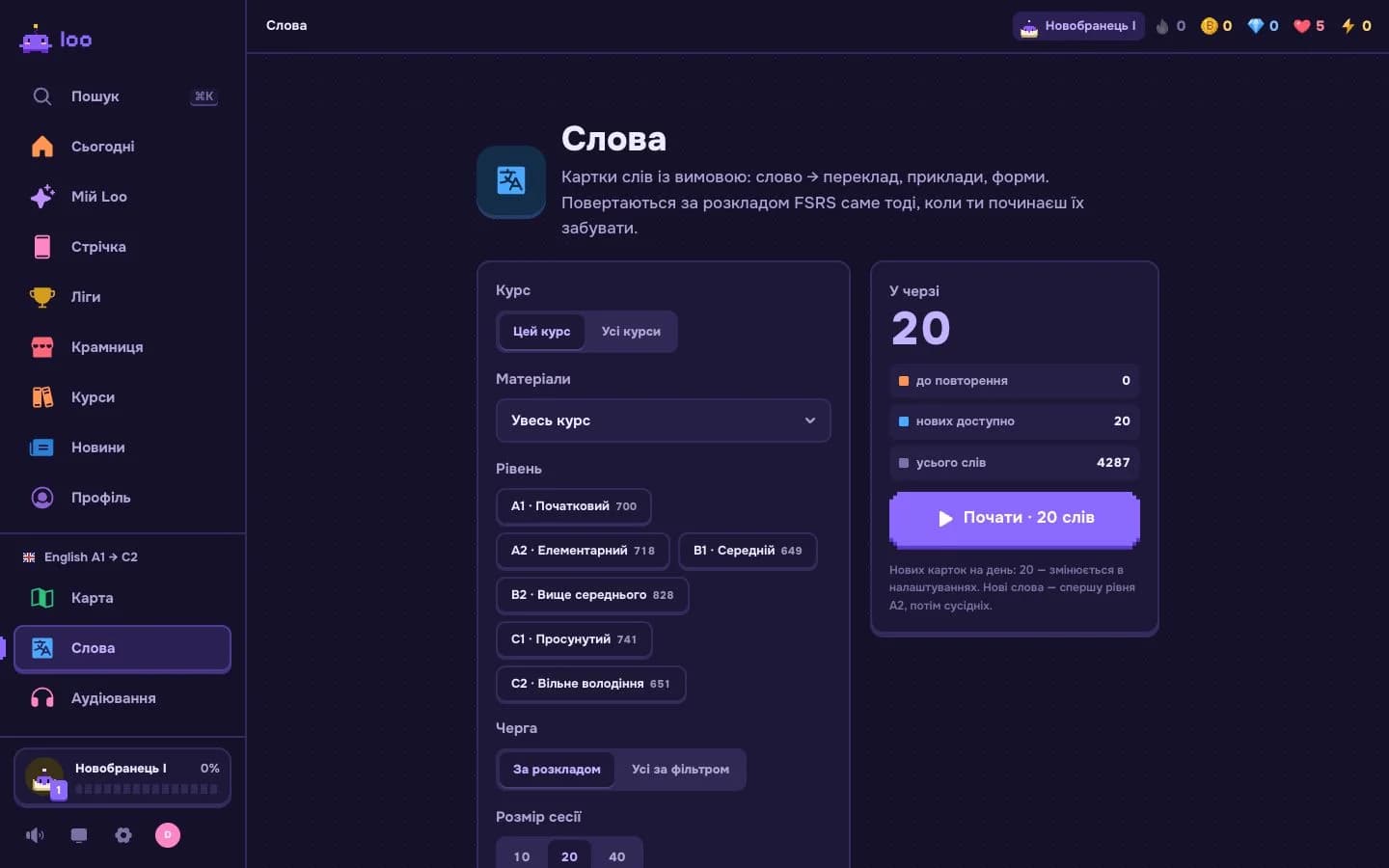
words with pronunciation and FSRS scheduling
779
lessons in the JavaScript Zero → Pro course
1,300+
unit tests on courses, progress and the game
56
steps on the learner's rank path
01The product
A learner opens the app for five minutes. Loo decides what to practise, checks every answer on the server and turns the habit into a game.
Step 1
Find your level
An adaptive placement test of about 30 questions sets the CEFR level by skill, with protection against guessing.
Step 2
Short lessons
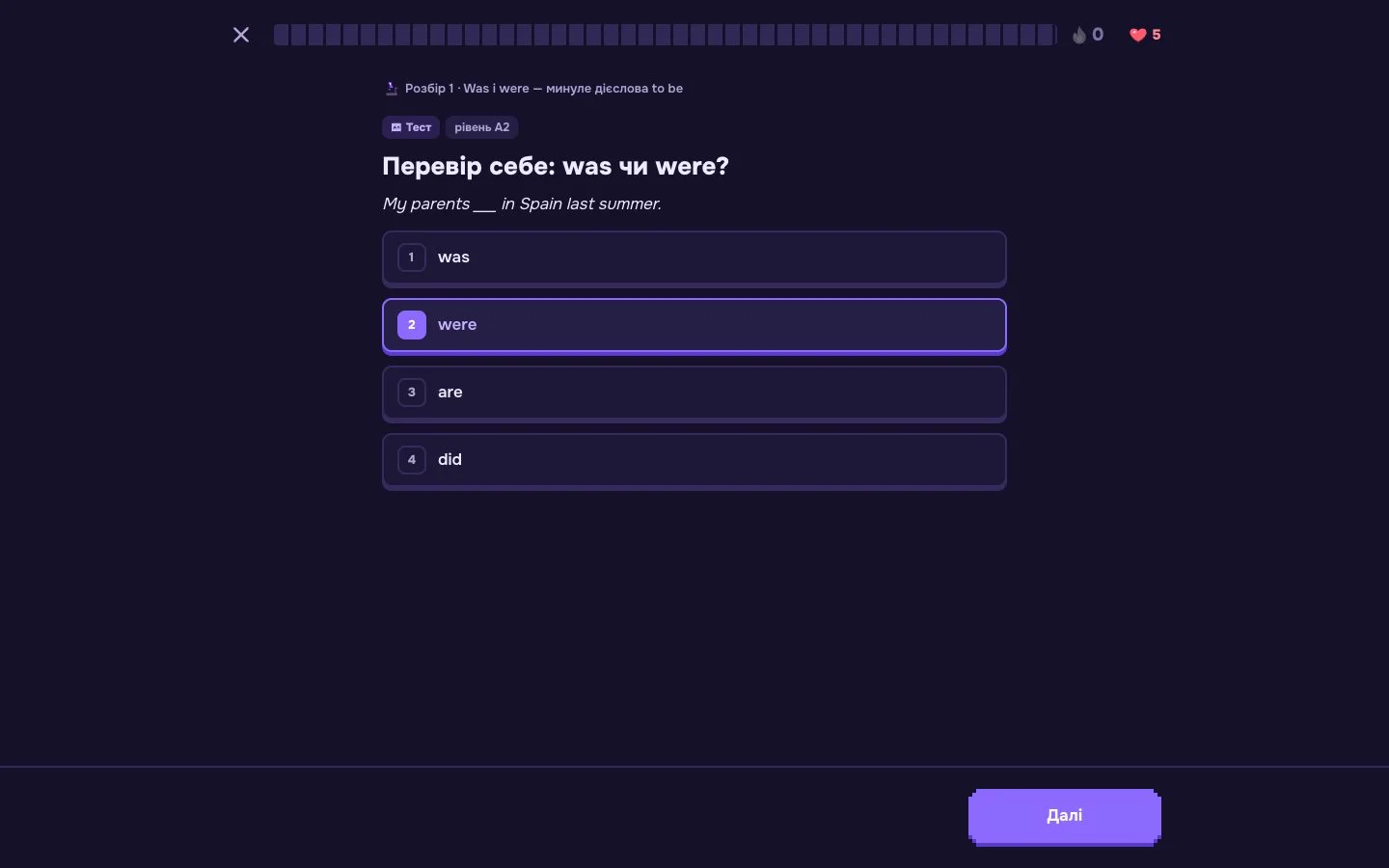
Predict, break down, reinforce: tests, cards, “what does this code print”, Parsons puzzles and coding tasks.
Step 3
Repeat at the right time
FSRS spaced repetition for cards and words; mistakes come back until they are answered right twice.
Step 4
Play the game
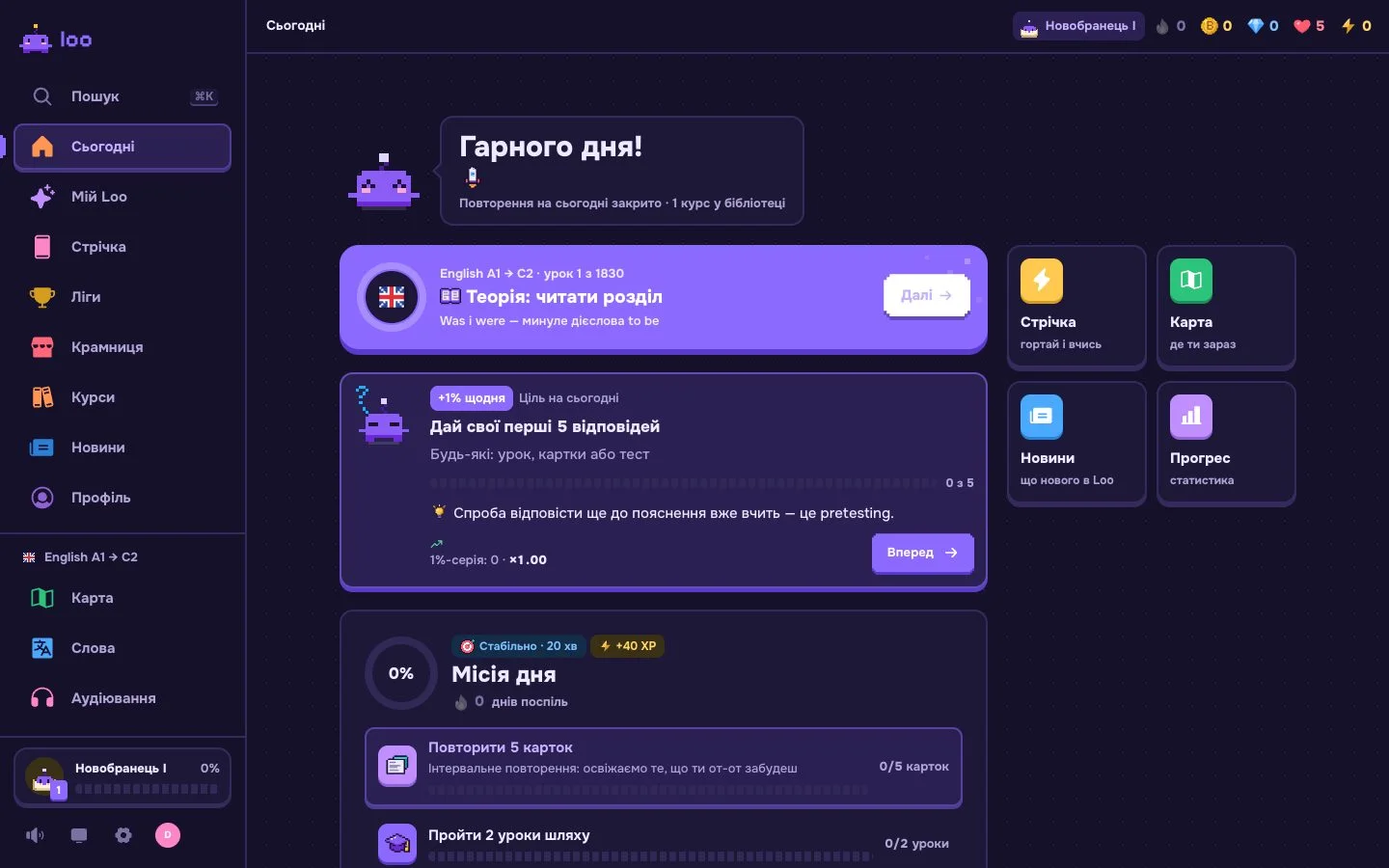
XP, coins and crystals, streaks with freezes, achievements and a mission of the day.
Step 5
Climb the league
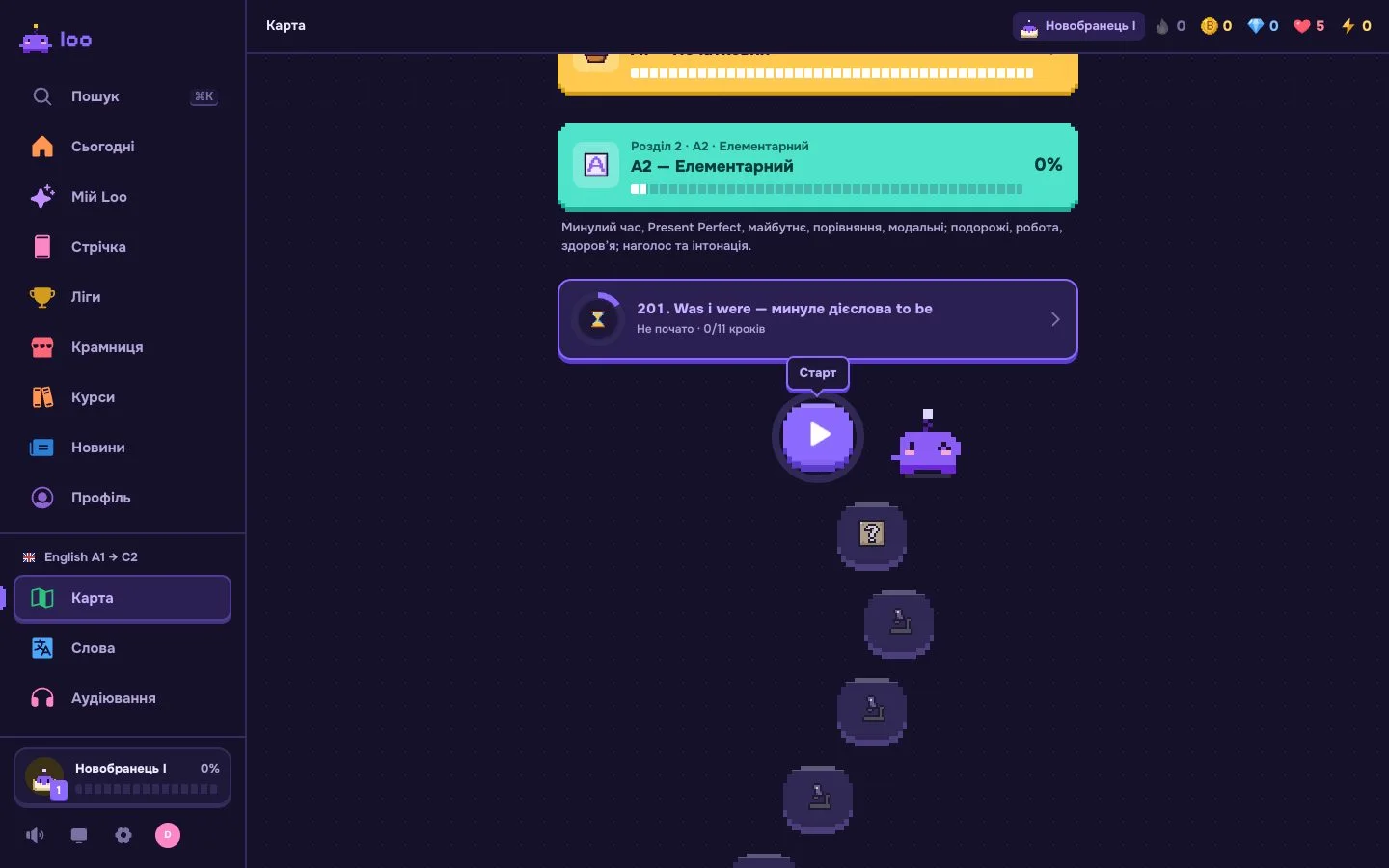
Weekly leagues of up to 30 learners across 10 tiers, and a rank path of 56 steps per course.
02Hard constraints
Gamified learning only works if the score means something. These rules shaped the architecture before the first screen.
0
answer keys sent to the browser
In graded steps the browser only gets the question; answers are checked by the server.
1
transaction for every reward
XP, hearts, leagues and currencies change together in one server transaction, so the economy can't drift.
RLS
on every progress table
Each row carries the learner's id and an own-rows policy; server-only tables have no client grants at all.
1
statement to read a page
Page data is read in a single query with cached content, keeping round trips to a minimum.
03How it was built
Each layer is plain logic first and UI second: content, course, progress and game live in their own modules with tests.
- 01
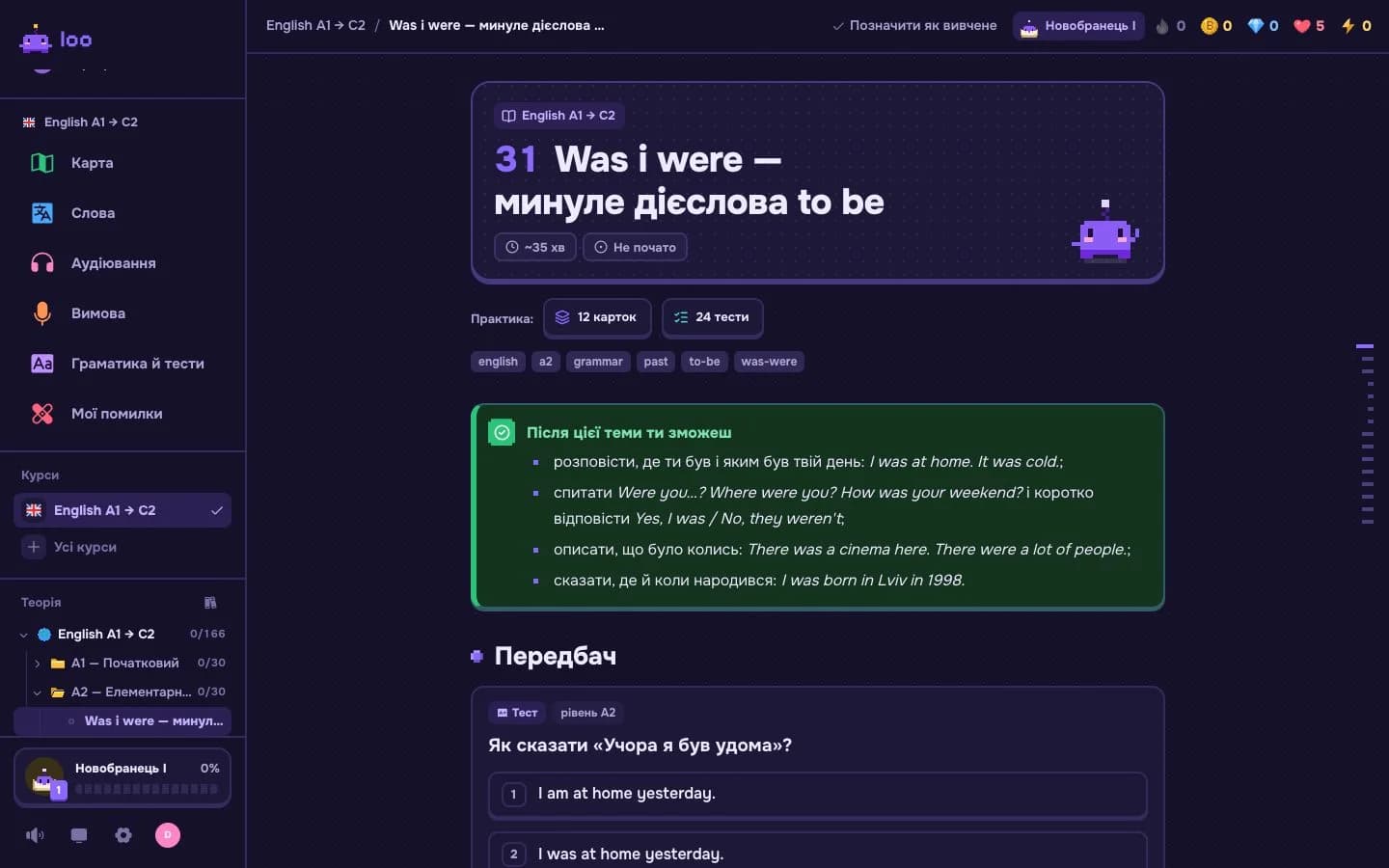
Courses as content, not code
A new course should be writing, not a release.
- Courses are Markdown in Obsidian plus a course manifest
- A compiler builds bundles: sections, topics, lessons, topic tests, exam pools
- Checks catch broken blocks, ids and links before anything ships
 02
A learning engine
Practice that follows what the learner forgets.
- FSRS scheduling for cards and words, and a separate mistakes session
- Adaptive CEFR placement test with skill levels for grammar, vocabulary, reading, listening and pronunciation
- Listening and pronunciation with browser speech synthesis and recognition
 03
A game economy
Rewards that are earned on the server.
- XP, coins and crystals, streaks with freezes, achievements and daily missions
- Weekly leagues with promotion and relegation
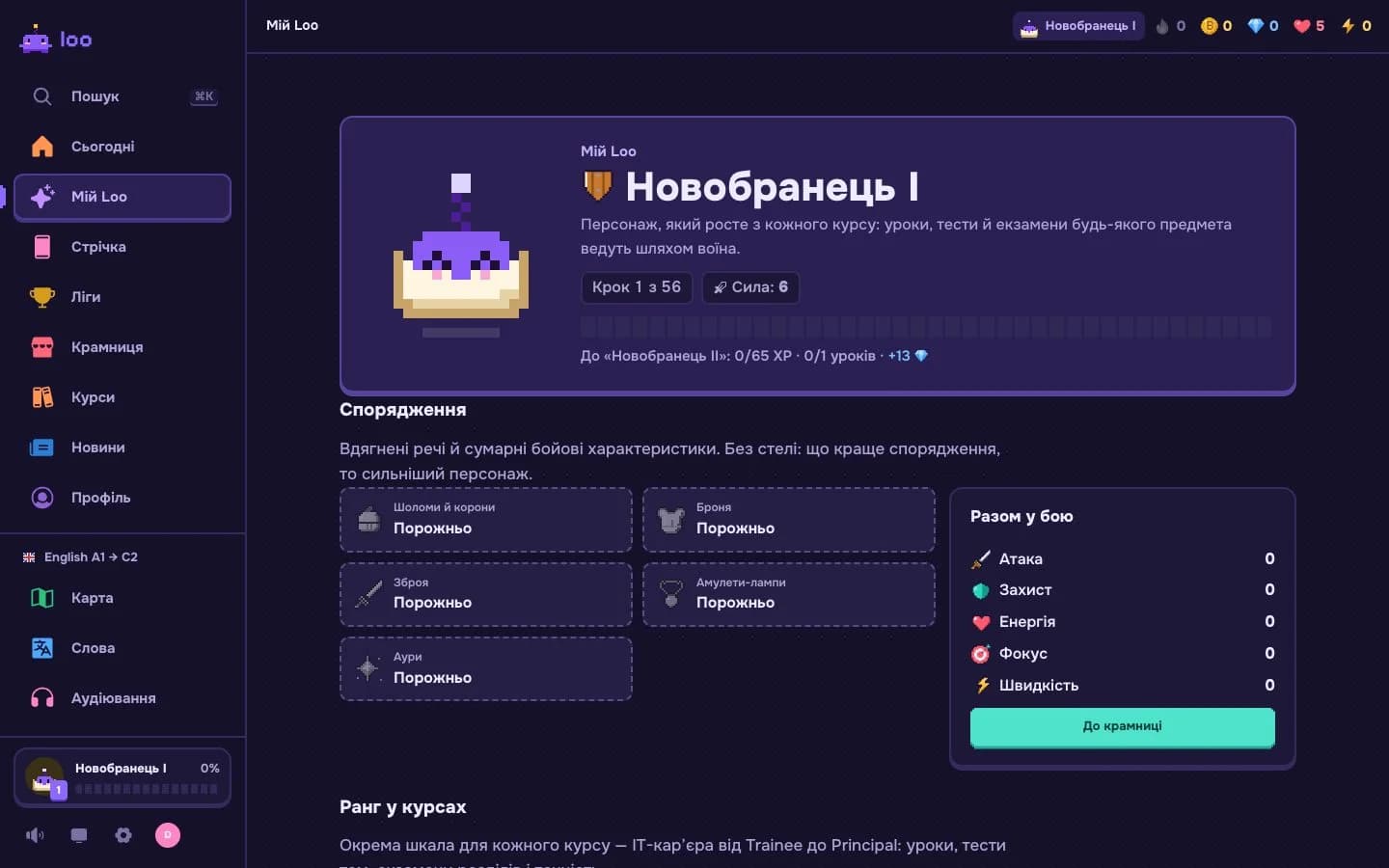
- A shop and gear with stats, the base for duels and bosses
 04
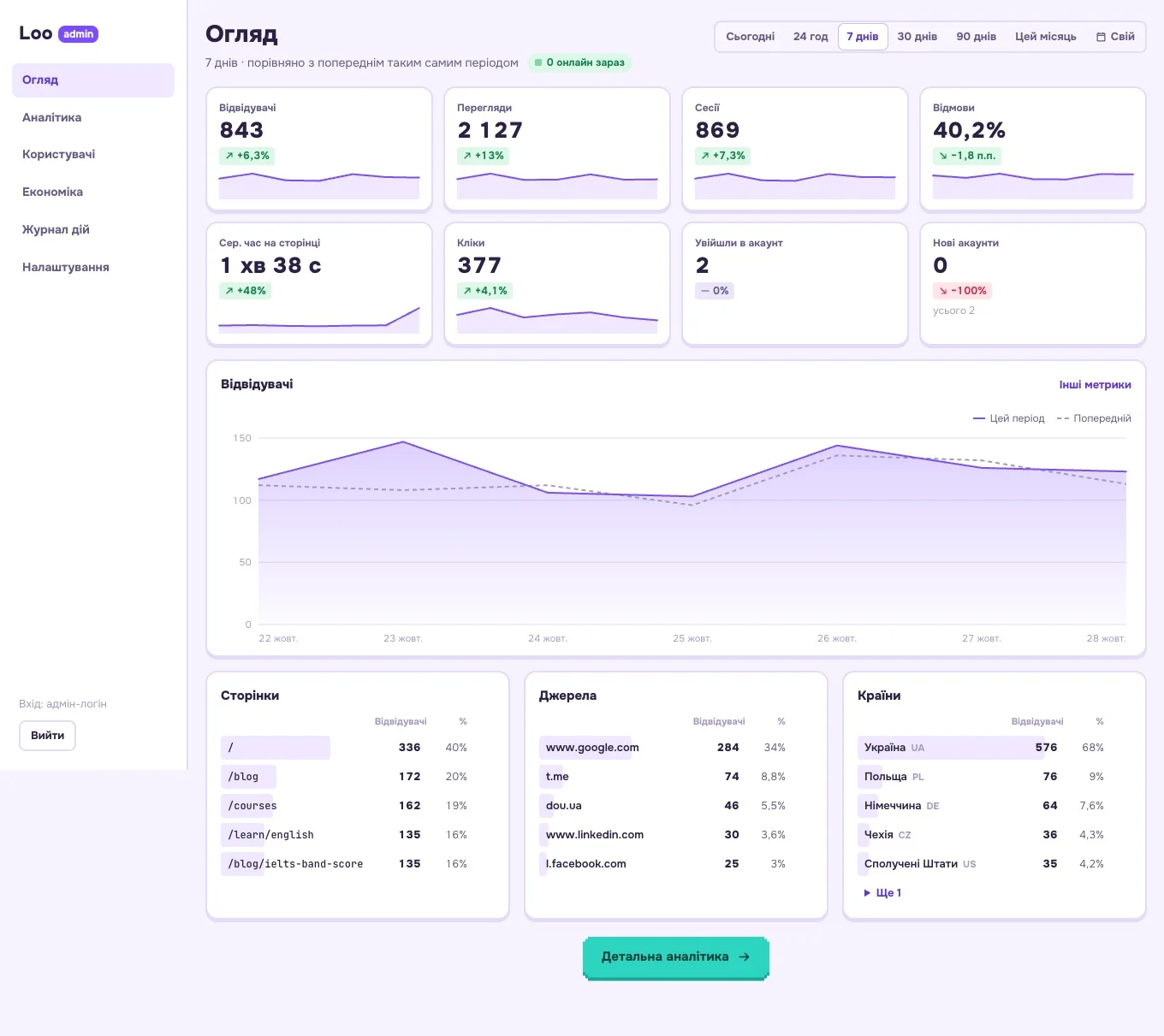
Run it like a product
Everything needed to grow without third-party tools.
- Own analytics: views, clicks, time on page, sources, UTM, countries and devices
- Admin for users, balances, the game economy and an audit log of every action
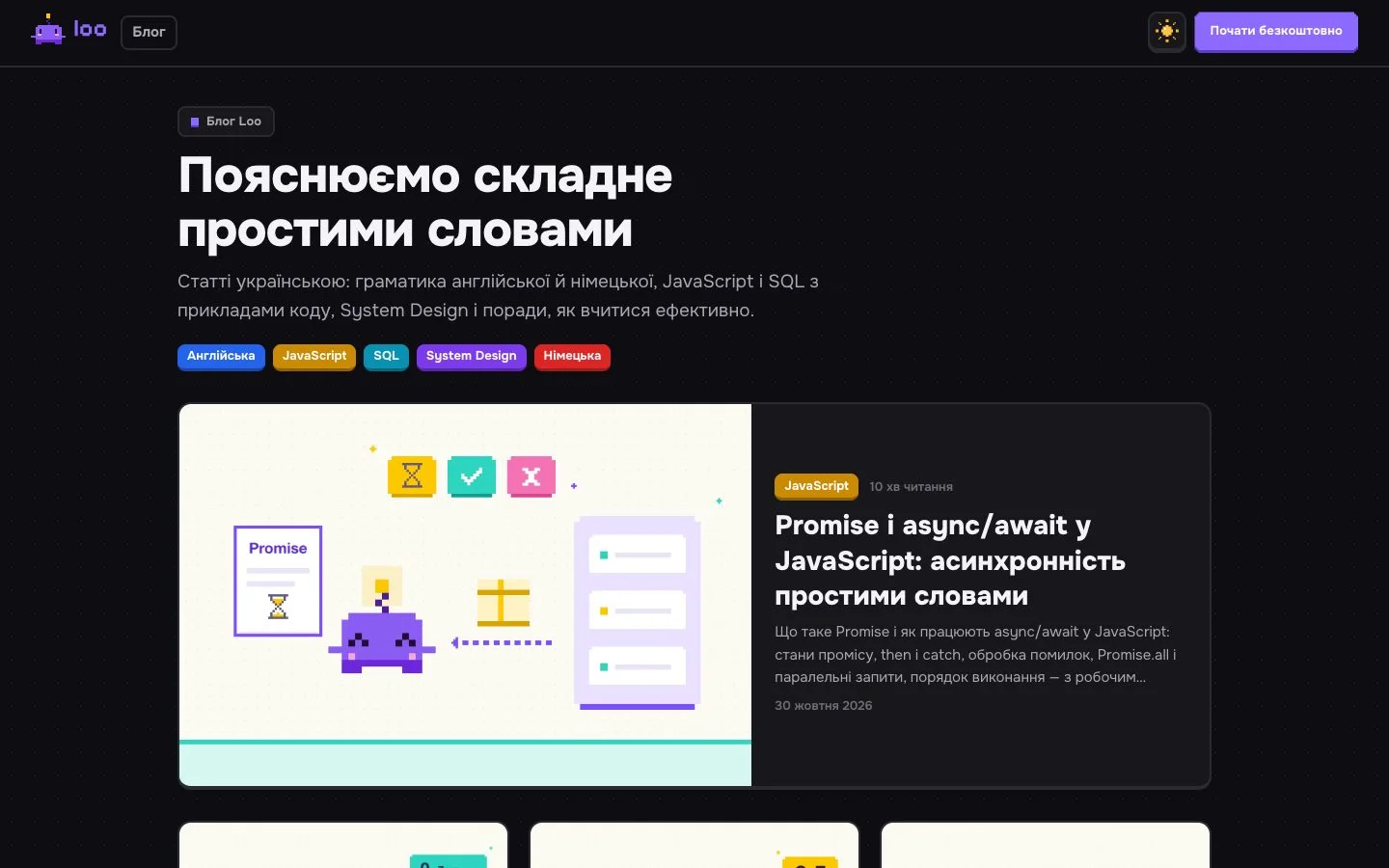
- Blog with static pages, OpenGraph cards, sitemap and IndexNow; PWA on the phone
04Inside the app
Real screens from the app. The admin view uses local demo data.
05Mobile
Bottom navigation, big buttons and an installable PWA, so a lesson fits into a queue or a commute.
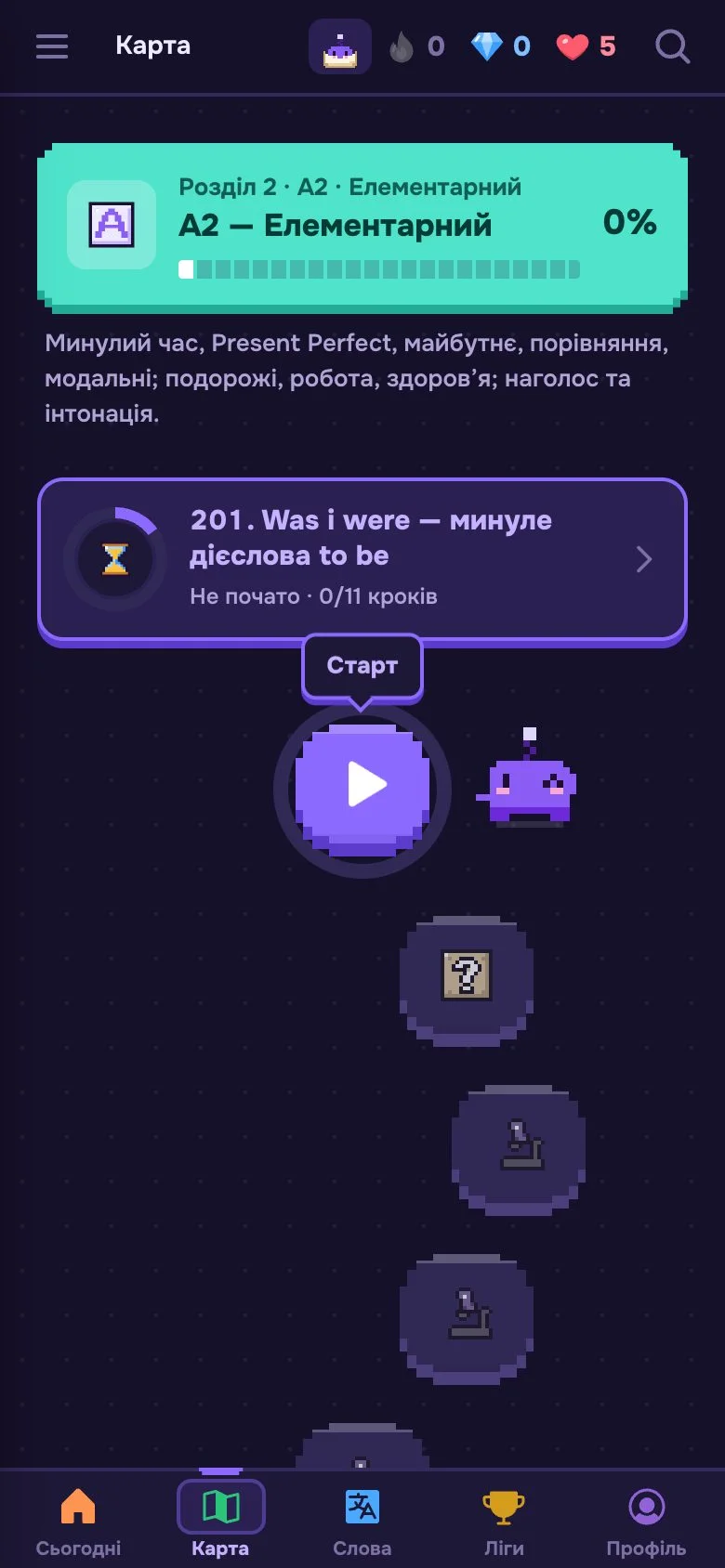
Course map
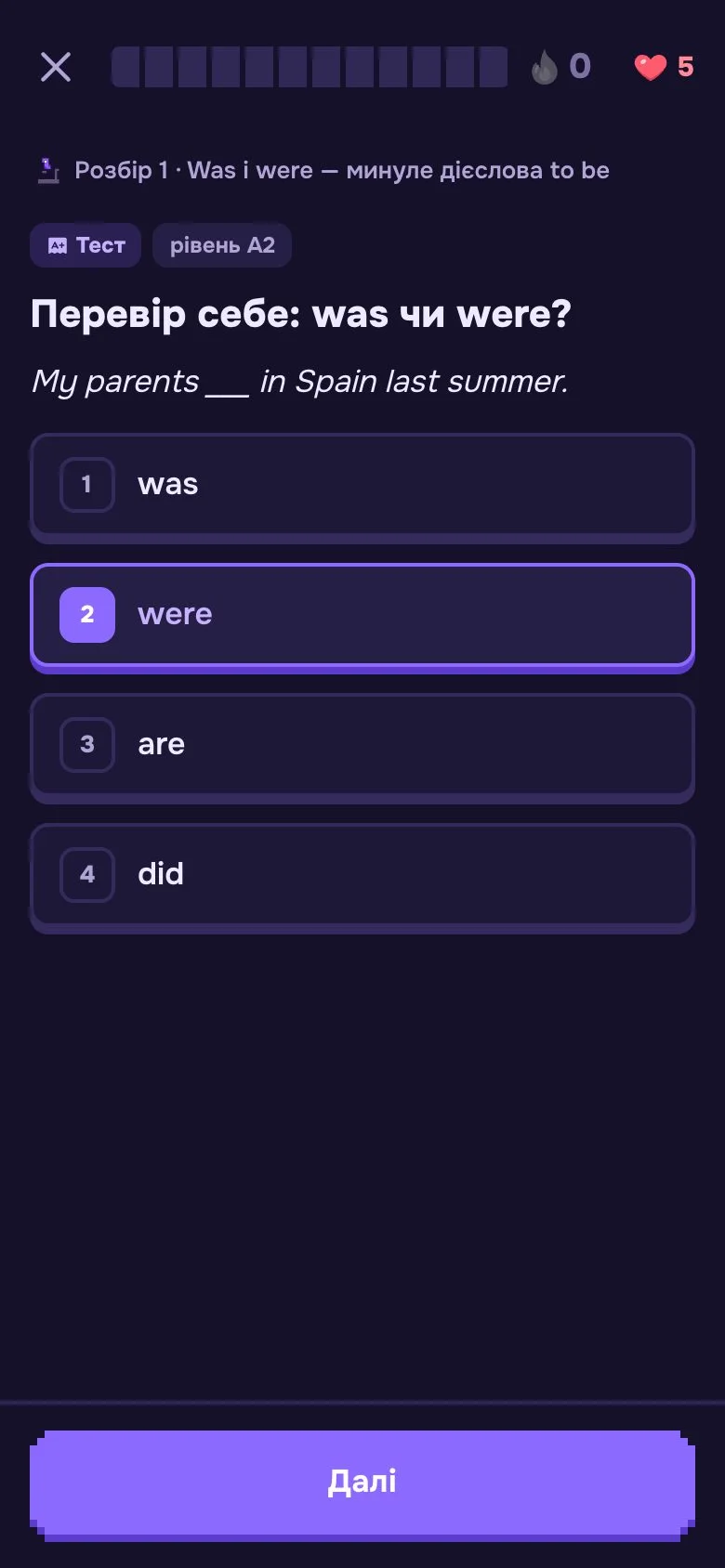
Lesson
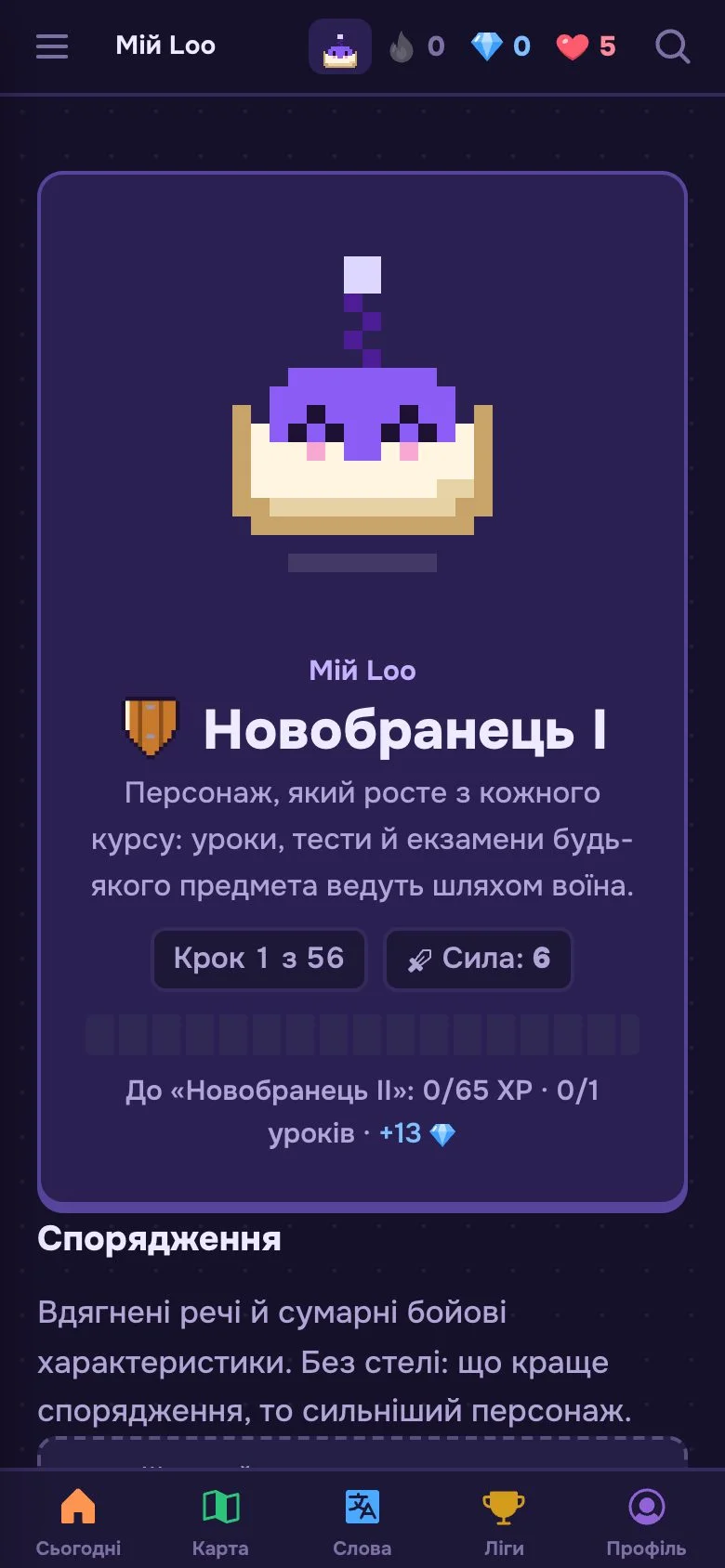
My Loo
06Outcome
Test suite
1,300+
Unit tests on the course compiler, progress, spaced repetition and the game economy, plus Playwright end-to-end tests of the study flow.
- A course pipelineMarkdown in, compiled course bundles out, with checks for blocks, ids and links.
- Two coursesJavaScript Zero → Pro and English A1 → C2 with placement, words, listening and pronunciation.
- Cheat-resistant progressServer-checked answers and one transaction per reward; progress private under row-level security.
- A full game loopXP, currencies, streaks, achievements, leagues, a shop, gear and a 56-step rank path.
- Own analytics and adminNo third-party trackers: views, sources, devices, users, economy and an audit log.
- Growth built inA blog for search with static pages, OpenGraph cards, sitemap and IndexNow.
- Privacy controlsLearners can download all their data as JSON or delete the account with all progress.
- On every screenResponsive web app and an installable PWA with keyboard shortcuts on desktop.
Framework
- Next.js 16
- React 19
- TypeScript strict
- Tailwind CSS 4
Data
- Supabase Postgres
- Drizzle ORM
- RLS
- Zod
Auth
- Supabase Auth
- GitHub
Learning
- ts-fsrs
- Adaptive placement
- Web Speech API
- Web Workers
Content
- Obsidian
- Markdown
- Course compiler
- MiniSearch
Ops and quality
- Vercel
- Resend
- Vitest
- Playwright
Have a product idea that has to work from the first user?
Let's build it end to end.